
Let’s be real for a second.
There is nothing quite as humbling as standing in your kitchen at 7:00 AM, staring at your coffee maker with blurry eyes, and realizing you have absolutely no idea how much coffee you’re supposed to put in the filter.
I’m 22, and I feel like I should have my life together enough to know the “golden ratio” by heart.
But instead, I usually find myself standing there like a confused contestant on a math game show, trying to remember if it’s two tablespoons per cup or two tablespoons per pot.
If you get it wrong, your morning is basically ruined.
Too little coffee and you’re drinking brown water that tastes like sadness.
Too much coffee and you feel like you can hear colors and see through time, which isn’t always the vibe for a Tuesday morning lecture or a shift at work.
If you’re trying to brew exactly 4 cups, you’re in the “sweet spot” for most small coffee makers, but the math can still be tricky.
Let’s break down exactly how much coffee you need for 4 cups of water so you can stop guessing and start caffeinating.
The Great “Cup” Conspiracy
Before we even touch the coffee bag, we have to talk about the biggest lie in the kitchen: the “cup.”
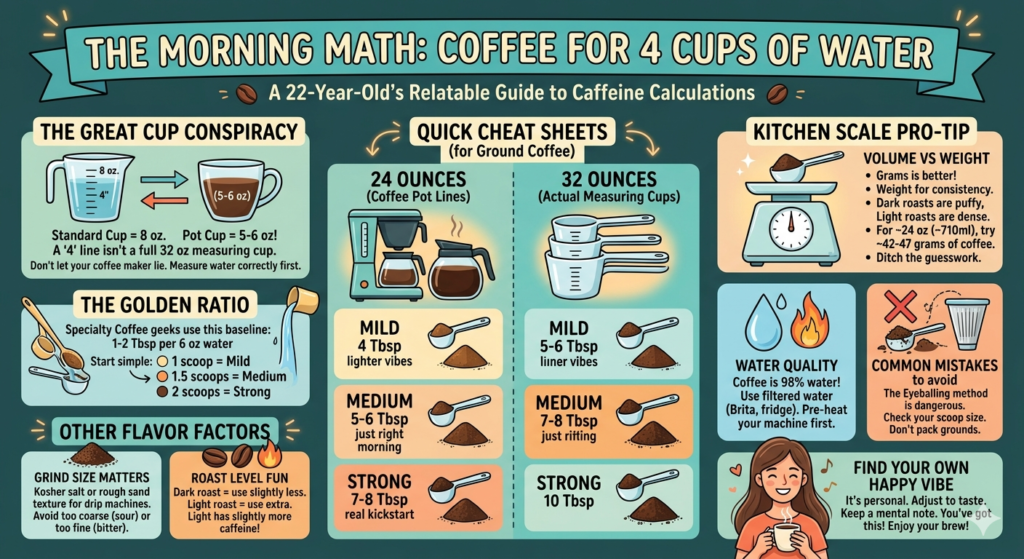
In the world of baking and standard liquid measurements, a cup is 8 ounces.
But in the world of coffee makers, a cup is usually only 5 or 6 ounces.
I know, it’s a total betrayal.
If you look at the side of your Mr. Coffee or your Black+Decker, those lines marked “4” aren’t 32 ounces (4 standard cups).
They are likely closer to 20 or 24 ounces.
This is the number one reason why people’s coffee tastes weak.
They use enough coffee for 4 measuring cups, but they’ve actually filled the pot with much less water.
For the sake of this guide, we’re going to look at both, so you’re covered no matter what you’re using to measure.
The Standard “Golden Ratio”
The Specialty Coffee Association (yes, that’s a real thing and they take this very seriously) recommends the “Golden Ratio.”
This is basically 1 to 2 tablespoons of ground coffee for every 6 ounces of water.
If you like your coffee on the lighter side, go with 1 tablespoon.
If you want it to actually wake you up and taste like a real cup of joe, 2 tablespoons is the way to go.
For 4 cups of water (assuming the 6-ounce coffee maker cups), that means you’re looking at 24 ounces of water total.
Using the Golden Ratio, you’ll need about 4 to 8 tablespoons of coffee.
I usually find that 5 or 6 tablespoons is the perfect middle ground for a standard drip machine.
Let’s Do the Math (The Non-Painful Way)
If you are using a standard 8-ounce measuring cup to fill your pot, you are dealing with 32 ounces of water.
That is more water, which means you need more beans.
For 32 ounces of water, you’ll want to use about 6 to 10 tablespoons of coffee.
Here is a quick cheat sheet for the “tablespoon method” based on your preferred strength:
For 24 ounces of water (The lines on your coffee pot):
Mild Coffee: 4 Tablespoons
Medium Coffee: 5 to 6 Tablespoons
Strong Coffee: 7 to 8 Tablespoons
For 32 ounces of water (Actual measuring cups):
Mild Coffee: 5 to 6 Tablespoons
Medium Coffee: 7 to 8 Tablespoons
Strong Coffee: 10 Tablespoons
Why You Might Want a Kitchen Scale
I know what you’re thinking. “I’m 22, I barely have a matching set of forks, why would I have a kitchen scale?”
But hear me out.
Measuring by tablespoons is okay, but it’s not super accurate.
A tablespoon of finely ground espresso-style coffee is way heavier than a tablespoon of coarse French Press coffee.
Also, different roasts have different densities.
Dark roast beans are “puffed up” and lighter, while light roast beans are dense and heavy.
If you want the exact same cup of coffee every single morning, measuring by weight (grams) is the only way to do it.
The most common ratio for coffee geeks is 1:15 or 1:17.
That means for every 1 gram of coffee, you use 15 to 17 grams of water.
For 4 cups (24 ounces / approx 710ml), you’d want about 42 to 47 grams of coffee.
It sounds extra, but it’s a game changer for the flavor.
Grind Size and How It Changes Everything
If you are using pre-ground coffee from the store, it’s probably a medium grind meant for drip machines.
That works perfectly with the tablespoon measurements we talked about.
But if you are grinding your own beans (which, honestly, makes the kitchen smell amazing), you have to be careful.
If your grind is too coarse (like sea salt), the water will rush through too fast and your 4-cup pot will taste sour and weak.
If your grind is too fine (like flour), the water will get stuck, and you’ll end up with a bitter, over-extracted mess.
Aim for a texture that looks like kosher salt or rough sand.
This allows the water to pull out all the good flavors in the 4 to 6 minutes it takes for the machine to run.
Roast Level: Light vs. Dark
People always think dark roast has more caffeine, but that’s actually a myth.
Light roast usually has slightly more caffeine because the beans aren’t roasted as long.
When it comes to measuring for your 4 cups, roast level matters for the flavor profile.
If you’re using a dark roast, the flavor is very intense and bold.
You might find that you can get away with using 5 tablespoons instead of 6 because the “roasty” flavor carries so much weight.
With a light roast, the flavors are more delicate and acidic.
I usually add an extra half-tablespoon of light roast just to make sure those floral and fruity notes really pop.
Don’t Forget the Water
This is the part everyone ignores.
Coffee is 98% water.
If your tap water tastes like chlorine or metal, your coffee is going to taste like chlorine or metal, no matter how expensive your beans are.
If you can, use filtered water from a Brita or a fridge dispenser.
It makes a massive difference in the clarity of the flavor.
Also, make sure your water is getting hot enough.
Most cheap coffee makers don’t actually get the water to the “ideal” 195 to 205 degrees Fahrenheit.
If your coffee always tastes a little flat, it might just be that your machine is tired.
A quick “hack” is to run a cycle of just water first to heat the machine up, then brew your actual coffee.
The Common Mistakes We All Make
We’ve all done it.
The “Eyeball Method” is the most dangerous game you can play.
You think you know what 6 tablespoons looks like in the filter, but you’re usually wrong.
Another mistake is using the “scoop” that came with the coffee maker.
Those scoops are usually 2 tablespoons, but sometimes they are weird sizes like 1.5 tablespoons.
Check the size of your scoop before you assume it’s a standard tablespoon.
Also, make sure you aren’t packing the coffee down into the filter.
You want it to be a nice, level bed of grounds so the water can flow through evenly.
If you pack it down like an espresso puck, the water will find the path of least resistance and “channel,” leaving half your grounds dry and un-used.
Adjusting to Your Own Taste
At the end of the day, these numbers are just a starting point.
If you make 4 cups with 6 tablespoons of coffee and you think it’s too strong, just drop it down to 5 next time.
Coffee is personal.
There is no “Coffee Police” that is going to break down your door because you like your brew a little bit weaker than the pros.
The goal is to find what makes you happy and helps you get through your day.
Keep a little mental note (or a note on your phone) of what worked.
“4 cups water + 6 tbsp Peet’s Coffee = Perfect” is a great thing to have saved for when you’re half-asleep on Monday morning.
Final Thoughts
Making coffee is part science, part art, and part survival skill.
Once you nail the ratio for 4 cups, you’ve basically mastered the most important part of your morning routine.
Whether you’re using a scale and a fancy burr grinder or just a regular old tablespoon and a bag of pre-ground beans, having a plan is better than guessing.
So, go grab your favorite mug, fill that pot to the “4” line, and toss in 6 tablespoons of your favorite roast.
You’re about to have a much better morning.
Happy brewing!