Let’s be totally real for a second. There is nothing quite as depressing as brewing a massive pot of coffee when you are the only person in the apartment.
You end up drinking one cup that is actually good, and then the rest just sits there getting cold and bitter on the burner until you eventually pour it down the sink at 2 PM. It is a waste of money, a waste of good beans, and honestly, it is just bad vibes.
If you are living that solo life or you are just the only one in your house who cares about a quality caffeine fix before noon, you need to master the art of the single-serve brew.
While everyone else is out here obsessed with plastic pods that taste like sadness, the French press is lowkey the GOAT for making a single, perfect cup. It gives you that main character energy in the morning without the waste.
But here is the thing: making French press coffee for one is a bit different than making a whole carafe. You have to be more precise because there is no room for error when you are only making 12 ounces.
If you have been wondering how to get that rich, velvety texture without ending up with a mouth full of grit or a cup that tastes like battery acid, I’ve got you. Let’s dive into the ultimate guide to the solo French press glow up.
Why the French Press is Your Best Friend
Before we get into the “how,” let’s talk about the “why.” Why should you bother with a French press when you could just press a button on a machine?
First, it is all about the oils. Paper filters in drip machines or pour-overs soak up a lot of the natural oils found in coffee beans. Those oils are where the flavor lives. Since the French press uses a metal mesh filter, all that goodness goes straight into your mug.
Second, it is a total sensory experience. There is something so satisfying about the smell of the bloom and the physical act of the plunge. It turns your morning into a ritual instead of a chore.
Third, it is surprisingly eco-friendly. No pods, no paper filters, just compostable grounds. It is a win for your taste buds and the planet.
The Essential Kit: What You Actually Need
You don’t need a fancy laboratory to make good coffee, but you do need a few key items if you want to be consistent.
The Press Itself
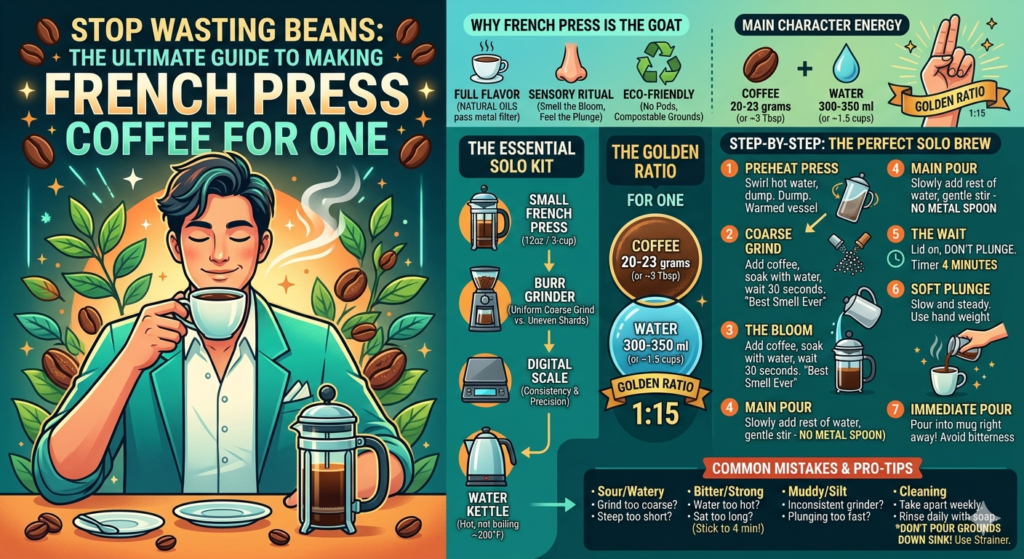
You can use a standard 34-ounce French press, but if you are almost always brewing for one, I highly recommend getting a small 12-ounce “three-cup” press. It is easier to clean, takes up less space, and the filter actually reaches the bottom of the carafe more effectively when you are working with small amounts of coffee.
The Grinder
If you take one thing away from this, let it be this: buy a burr grinder. Blade grinders (the ones that look like tiny blenders) chop the beans into uneven shards. Some are dust, some are chunks. This leads to an uneven brew that tastes both sour and bitter at the same time. A burr grinder gives you a uniform coarse grind, which is essential for a French press.
The Scale
I know, I know. Using a scale feels a bit “extra.” But coffee is basically chemistry. If you use “two big spoons” of coffee today and “three little ones” tomorrow, your coffee will never taste the same twice. A cheap digital scale ensures you hit the golden ratio every single morning.
The Water Kettle
You don’t need a fancy gooseneck kettle for a French press like you do for a pour-over, but you do need hot water. Just make sure it isn’t literally boiling. Boiling water (212°F) can scorch the grounds and make the coffee taste burnt.
The Golden Ratio for One
The secret to a perfect cup is the ratio of coffee to water. For a single serving, I usually aim for about 300 to 350 milliliters of water. That is roughly a standard-sized mug.
To match that amount of water, you want about 20 to 23 grams of coffee. If you are using a ratio, 1:15 is a great place to start. That means 1 part coffee to 15 parts water.
If you don’t have a scale yet (though you should get one!), this is roughly 3 level tablespoons of coarsely ground coffee for every 1.5 cups of water.
Step-by-Step: The Perfect Solo Brew
Okay, let’s get into the actual process. Put your favorite playlist on and let’s make some magic.
1. Preheat the Press
Pour some hot water into your empty French press and swirl it around. This warms up the glass or stainless steel so your coffee doesn’t lose temperature the second it hits the carafe. Dump that water out before you start.
2. The Coarse Grind
Grind your beans to a coarse consistency. It should look like sea salt or cracked peppercorns. If it is too fine (like espresso powder), it will clog the filter and make the coffee over-extracted and muddy.
3. The Bloom
Add your 20-23 grams of coffee to the press. Pour just enough hot water (about 200°F) over the grounds to soak them. Stop and wait for 30 seconds. You’ll see the coffee “bloom” or bubble up. This releases the carbon dioxide and allows the water to actually penetrate the grounds. Tbh, this is the best smelling part of the whole day.
4. The Main Pour
Slowly pour in the rest of your water. Give it a very gentle stir with a wooden or plastic spoon. Avoid metal spoons so you don’t accidentally crack the glass carafe.
5. The Wait
Place the lid on top but do not plunge yet. Set a timer for 4 minutes. This is the “sweet spot” for extraction. While you wait, you can prep your creamer or just stare out the window and contemplate your life choices.
6. The Soft Plunge
When the timer goes off, it is time to plunge. Do not go full strength on it. Use the weight of your hand to slowly and steadily push the filter down. If you feel massive resistance, stop for a second and then continue.
7. The Immediate Pour
As soon as you finish the plunge, pour that coffee into your mug. Do not let it sit in the press! Even with the filter down, the coffee is still technically brewing. If it sits in there for another ten minutes, it will become bitter and over-powered.
Common Mistakes: Why Does Mine Taste Weird?
If your coffee doesn’t taste like the heavens opening up, don’t panic. It is usually one of three things.
If it tastes sour or watery, your grind was likely too coarse or you didn’t let it steep long enough. Try a slightly finer grind next time or add 30 seconds to the timer.
If it tastes bitter or way too strong, you probably used water that was too hot or let it sit in the press too long after plunging. Remember: 4 minutes is the goal.
If it tastes “muddy” or has a lot of silt at the bottom, your grinder might be inconsistent, or you are plunging too fast. A little bit of sediment is normal for a French press, but it shouldn’t feel like you are drinking sand.
Maintaining the Vibe: Cleaning Your Press
Cleaning a French press is lowkey annoying, but it is necessary. If you leave old oils and grounds in there, they will go rancid and make your next cup taste like an old gym sock.
Most French presses can be taken apart. Unscrew the filter assembly once a week and give the mesh a deep clean. For daily use, just rinse it thoroughly with hot water and a little bit of dish soap.
Pro-tip: Don’t pour your used coffee grounds down the sink unless you want a massive plumbing bill. Use a small mesh strainer to catch them and throw them in the compost or the trash.
The Bottom Line
Making French press coffee for one is a total power move. It shows that you value your morning routine and you aren’t willing to settle for mediocre coffee just because you are brewing a single cup.
It takes about five minutes of your time, but the payoff is a rich, flavorful, and cafe-quality experience right in your kitchen.
So, stop settling for those watered-down pods. Get yourself a small press, some high-quality beans, and start treating your morning with the respect it deserves.
You’ve got the ratio, you’ve got the steps, and you definitely have the vibe. Now go brew the best cup of your life!