Let’s have a heart to heart about your morning coffee routine. If you are still reaching for those plain white sugar packets or, heaven forbid, that dusty canister of granulated sugar that’s been in your pantry since you moved in, we need to talk.
I’m 22, and if there is one thing my generation has mastered, it is the art of the “elevated” coffee experience.
We aren’t just drinking caffeine to wake up anymore. We are drinking it for the aesthetic, the flavor profile, and the sheer joy of a well-crafted beverage.
Lately, I’ve been seeing everyone obsess over fancy syrups and expensive creamers, but the real game changer has been hiding in your baking cabinet this whole time.
I’m talking about brown sugar.
Is brown sugar good in coffee?
The short answer is: absolutely yes. It is the glow-up your caffeine fix has been begging for. But there is a bit more to it than just tossing a spoonful into your mug and calling it a day.
Let’s dive into why this swap is the best decision you’ll make for your taste buds this week.
Is Brown Sugar Good in Coffee?
The Science of the Flavor: It Is Not Just Sweet
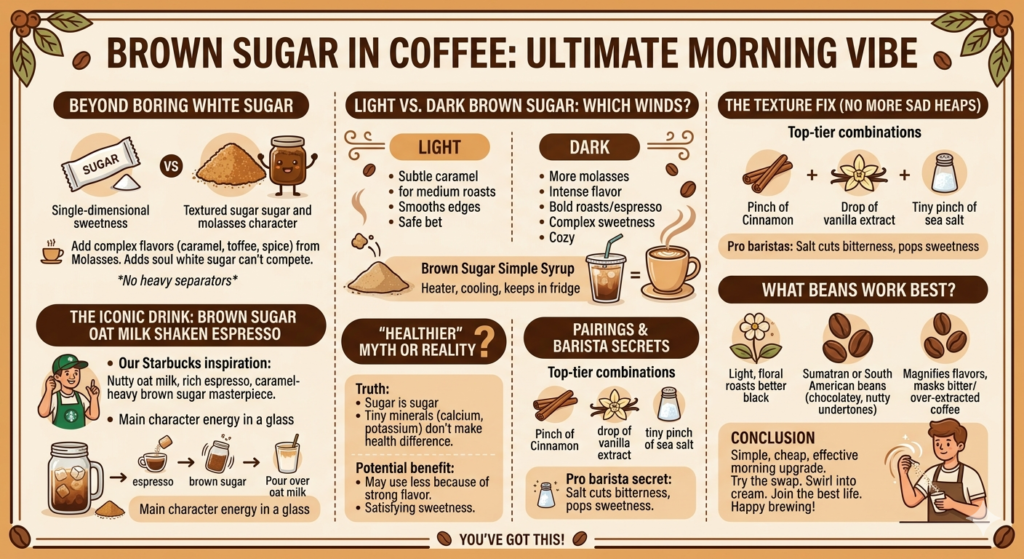
When you use white sugar, you are basically just adding sweet to your coffee.
White sugar is refined until it is just pure sucrose. It’s one-dimensional.
Brown sugar, on the other hand, is white sugar that still has its molasses content, or has had molasses added back into it.
That tiny difference changes everything. Molasses brings a deep, toasted, almost smoky flavor to the party.
When you stir that into a hot cup of coffee, you aren’t just sweetening the bitterness.
You are adding notes of caramel, toffee, and even a hint of spice.
It makes your cheap grocery store coffee taste like it came from a boutique roastery where the barista has a very cool apron and a complicated mustache.
It adds a “soul” to the drink that white sugar just can’t compete with.
Light Brown vs. Dark Brown: Which One Wins?
If you go to the store, you’ll see two main types: light and dark.
As a self-proclaimed coffee enthusiast, I have tried both extensively. Light brown sugar is the safe bet. It has a subtle caramel vibe that plays really well with medium roasts.
It doesn’t overpower the coffee, it just smooths out the edges.
Dark brown sugar is for the bold. It has more molasses, which means the flavor is much more intense. If you like a dark roast or a really strong espresso, dark brown sugar is the move.
It creates this rich, complex sweetness that reminds me of a cozy autumn morning even if it’s 90 degrees outside.
Honestly, I usually keep both on hand depending on my mood, but if you’re just starting your brown sugar journey, go with light first.
The Texture Problem (And How to Fix It)
One thing you might notice when you start using brown sugar is that it likes to clump.
White sugar is like that easy-going friend who fits in anywhere.
Brown sugar is a bit more high-maintenance. It’s moist, it’s sticky, and sometimes it just sits at the bottom of your mug in a sad little heap.
If you are making a hot coffee, this usually isn’t a huge deal. Just give it a really good stir while the coffee is piping hot.
But if you are a cold brew or iced coffee lover, you are going to run into issues. Brown sugar does not like to dissolve in cold liquids.
You’ll end up with a drink that isn’t sweet at all, followed by a final sip that is basically just a mouthful of wet sand. Not the vibe.
The fix? Make a brown sugar simple syrup.
It sounds fancy and “adult,” but it’s actually the easiest thing in the world.
Just take equal parts brown sugar and water, heat them in a small pot until the sugar dissolves, and let it cool.
Keep it in a jar in your fridge.
Now you have professional-grade coffee sweetener that mixes perfectly into your iced lattes.
This is literally how the big coffee chains do it, and you can do it at home for about fifty cents.
The Iconic Brown Sugar Oat Milk Shaken Espresso
We have to address the elephant in the room.
The reason brown sugar in coffee is having such a massive moment right now is 100 percent because of the Starbucks Brown Sugar Oat Milk Shaken Espresso.
I’ll admit it: that drink is a masterpiece.
There is something about the combination of nutty oat milk, rich espresso, and that caramel-heavy brown sugar that just hits different.
The reason this works so well is because oat milk naturally has a bit of a toasted flavor.
When you pair it with the molasses in brown sugar, they highlight the best parts of each other.
If you haven’t tried this combo at home yet, consider this your sign.
You don’t even need a fancy shaker. Just put your espresso, brown sugar, and ice in a mason jar, shake it like your life depends on it, and pour it over oat milk.
It is “main character energy” in a glass.
Is It “Healthier” Than White Sugar?
I hate to be the bearer of bad news, but we have to keep it real here.
There is a common myth that brown sugar is somehow “healthier” or more “natural” than white sugar.
At the end of the day, sugar is sugar.
The amount of minerals in the molasses (like calcium and potassium) is so tiny that it doesn’t actually make a difference for your health.
If you are switching because you think you are being a wellness guru, you might be disappointed.
However, because brown sugar has a much stronger flavor, I find that I actually use less of it.
One teaspoon of brown sugar feels like it does more for my coffee than two teaspoons of white sugar.
So, in a roundabout way, it might help you cut back on your total sugar intake just because the flavor is so much more satisfying.
But mostly, we are doing this for the taste, not the vitamins.
Pairing Brown Sugar With Spices
Since you are already stepping up your game with brown sugar, you might as well go all the way.
Brown sugar is the perfect “base” for other flavors.
If you want to feel like you’re living in a cozy indie movie, try adding a pinch of cinnamon to your brown sugar.
The warmth of the cinnamon and the depth of the molasses is a top-tier combination.
You can also try a tiny drop of vanilla extract or even a tiny pinch of sea salt.
The salt actually helps cut the bitterness of the coffee and makes the sweetness of the brown sugar pop even more.
It sounds weird, I know, but trust me on the salt. It’s a pro barista secret.
What Kind of Coffee Works Best?
Not all coffee is created equal when it comes to sweetening.
If you are drinking a super expensive, light-roasted Ethiopian coffee with floral and citrus notes, you probably shouldn’t put brown sugar in it.
In fact, you probably shouldn’t put anything in it. Those coffees are meant to be tasted black.
But for your everyday “I need to get to work” coffee, brown sugar is amazing.
It works best with South American or Sumatran beans that already have chocolatey or nutty undertones.
The brown sugar acts like a magnifying glass for those flavors.
It’s also the perfect way to save a cup of coffee that turned out a little bit too bitter or over-extracted.
The molasses notes are great at masking those “burnt” flavors that sometimes happen when you aren’t paying attention to your brew timer.
My Final Verdict
At the end of the day, your coffee is your business.
If you like it black, stay strong. If you like it with five pumps of sugar-free hazelnut, you do you.
But if you are looking for a simple, cheap, and incredibly effective way to make your morning feel a little more special, try the brown sugar swap.
It’s one of those tiny life upgrades that makes a big difference.
It feels more intentional. It tastes more expensive.
And honestly, there is something very satisfying about the way a spoonful of brown sugar looks as it swirls into a splash of cream.
So, go ahead and raid your baking supplies.
Your morning coffee is about to get a whole lot better.
I’ll be over here with my brown sugar oat milk latte, living my best life.
You should join me.
Happy brewing!