Let’s be real for a second. Being 22 is basically just one long, caffeinated fever dream. Whether you’re trying to survive a 9 to 5 that feels like a 9 to midnight, finishing a thesis that’s 48 hours overdue, or just trying to look like a functional adult who doesn’t live off energy drinks, coffee is the literal fuel.
But there is nothing, and I mean nothing, worse than stumbling into the kitchen at 7 AM, eyes half glued shut, and brewing a pot of coffee that tastes like hot bean water. Or worse, coffee that’s so strong it feels like you’re drinking straight battery acid.
We’ve all been there. You wing it. You throw a few scoops in, hope for the best, and end up with a cup that’s just mid.
If you’re tired of playing Coffee Roulette and wants to know the answer to how much coffee grounds per cup you’ve come to the right place. I’ve done the deep dives, ruined my own sleep schedule, and talked to people who actually know what they’re doing to bring you the ultimate guide on how much coffee grounds per cup you actually need.
How Much Coffee Grounds Per Cup
The Golden Ratio: The Secret Sauce of Coffee
If you want to sound like a pro (or just want your coffee to taste consistent), you need to know about the Golden Ratio.
The Specialty Coffee Association (yes, that’s a real thing) suggests a ratio of roughly 1:18.
This means for every 1 gram of coffee, you use 18 grams of water.
Now, I know what you’re thinking, I’m an English major, I didn’t come here for math. Don’t worry. I’ve done the heavy lifting for you.
If you don’t own a fancy digital scale and just want to get your caffeine fix, here is the close enough rule of thumb:
Use 2 level tablespoons of ground coffee for every 6 ounces of water.
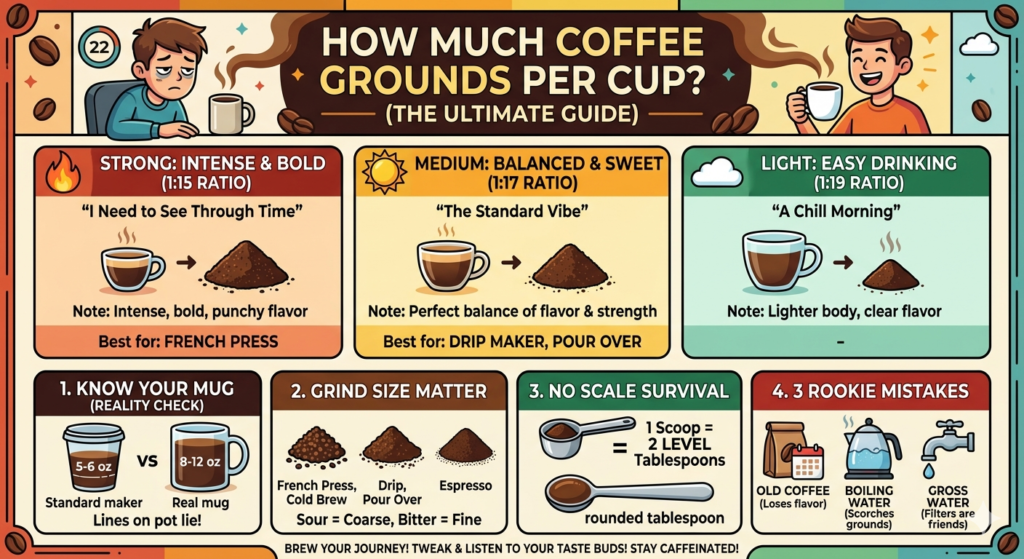
Most standard coffee mugs are actually 8 to 12 ounces, so if you’re filling up a big World’s Best Boss mug, you’re looking at about 2.5 to 3 tablespoons.
Why One Cup is a Lie
Here is the biggest trap in the coffee world: The lines on your coffee pot.
You see the number 6 and think, Sweet, six cups of coffee. Wrong. In the world of coffee makers, a cup is usually only 5 or 6 ounces. In the real world, a cup is whatever fits in your favorite ceramic mug, which is usually way bigger.
If you use one scoop of coffee for every cup marked on the machine, you’re probably going to end up with a very weak, disappointing brew.
The Coffee Math Breakdown
For those of you who want to get technical (or just want to make sure your $20 bag of craft beans doesn’t go to waste), here is a simple breakdown using the 1:15 (Strong) and 1:18 (Light/Standard) ratios.
Coffee-to-Water Ratio Table
| Desired Strength | Coffee Grounds | Water (Ounces) | Result |
| The “I Need to See Through Time” (1:15) | 2.5 Tbsp | 6 oz | Intense, bold, punchy. |
| The Standard Vibe (1:17) | 2 Tbsp | 6 oz | Balanced, sweet, clear. |
| The Chill Morning (1:19) | 1.5 Tbsp | 6 oz | Light, easy to drink. |
Does the Grind Size Actually Matter?
Short answer: Yes. Big time.
Think of coffee grounds like pebbles vs. sand. If you pour water through a bucket of pebbles, it rushes through. If you pour it through sand, it takes a while.
- Coarse (Pebbles): Best for French Press or Cold Brew. Since the water sits with the coffee for a long time, you need big chunks so it doesn’t get bitter.
- Medium (Sea Salt): The MVP. Perfect for your standard drip coffee maker or a Pour Over.
- Fine (Table Salt): Espresso territory. The water is forced through so fast that it needs a lot of surface area to grab that flavor.
If your coffee tastes sour or salty, your grounds are too coarse (under extracted). If it tastes bitter or burnt, your grounds are too fine (over extracted).
Measuring by Method: One Size Doesn’t Fit All
Your brewing method changes the rules. You can’t treat an AeroPress like a 12 cup Mr. Coffee.
1. The Drip Coffee Maker (The Reliable Roommate)
This is the classic. Use the 2 tablespoons per 6 oz rule. If you’re making a full 12 cup pot (which is actually about 60 oz of water), you’ll need about 10 to 12 tablespoons of coffee.
2. The French Press (The Weekend Main Character)
French Press is “immersion” brewing, meaning the coffee just sits in the water.
- Ratio: 1:15 is usually the sweet spot here.
- Measurement: About 3 tablespoons for every 1 cup (8 oz) of water.
- Pro Tip: Don’t let it sit for more than 4 minutes, or it’ll start tasting like dirt.
3. The Pour Over
This is for when you want to taste the notes of blueberry and chocolate the bag promised.
- Ratio: 1:16.
- Measurement: 22 grams of coffee for 350 grams of water. (Yeah, you definitely need a scale for this one if you want it to be perfect).
4. Cold Brew (The Summer Savior)
Cold brew is a concentrate, so the rules are totally different. You’re basically making coffee syrup.
- Ratio: 1:4 or 1:5.
- Measurement: 1 cup of coarsely ground coffee to 4 cups of cold water. Let it sit in the fridge for 12 to 24 hours. Dilute it with milk or water later so you don’t have a heart attack.
3 Rookie Mistakes That Are Ruining Your Brew
Even if you get the measurements perfect, these three things can still sabotage your morning.
1. Using “Old” Coffee
Coffee starts losing flavor the second it’s ground. If you’re buying those massive pre ground tubs that have been sitting on the shelf since last Thanksgiving, it’s never going to taste amazing.The Fix: Buy whole beans and grind them right before you brew. It sounds extra, but it’s the biggest glow up your coffee can get.
2. Using Boiling Water
If you pour boiling water ($100^{\circ}C$) straight onto your grounds, you’re basically scorching them. It’s like overcooking a steak.The Fix: Let your kettle sit for about 30 to 60 seconds after it whistles. You’re aiming for around $90^{\circ}C$ to $96^{\circ}C$.
3. Using “Gross” Water
Coffee is 98% water. If your tap water tastes like a swimming pool or a rusty pipe, your coffee will too.The Fix: Use a basic water filter. Your taste buds (and your machine) will thank you.
The I Don’t Have a Scale Survival Guide
Look, we’re all out here doing our best. If you’re in a dorm or a shared apartment and your only tool is a literal soup spoon, here is how to eyeball it:
- A standard coffee scoop is usually 2 tablespoons.
- A rounded tablespoon (with a little mountain on top) is closer to 1.5 tablespoons.
- A “cup” of water is roughly the size of a standard soda can (12 oz).
So, for one big mug of coffee, use two very rounded tablespoons of grounds.
Final Thoughts: It’s Your Journey
At the end of the day, coffee is subjective. Some people like it so strong it could wake the dead; others like it light and tea like.
Start with the 2 tablespoons per 6 oz rule, and then tweak it.
- Too strong? Use a little more water next time.
- Too weak? Add another half spoon of grounds.
Don’t let the coffee snobs make you feel bad for how you like your drink. Whether you’re adding three pumps of vanilla syrup or drinking it black and bitter like your soul, the best cup of coffee is the one that makes you feel ready to take on the world.
Now go forth and brew something actually drinkable. You’ve got this.
FAQ: Quick Hits
How many scoops of coffee for 4 cups? For a 4 cup maker (approx. 20 to 24 oz), use 8 tablespoons of coffee.
How much coffee for 12 cups? For a full 12 cup pot (approx. 60 oz), use 20 to 24 tablespoons (which is about 1.5 cups of grounds).
Is a coffee scoop a tablespoon? Usually, one level coffee scoop equals 2 tablespoons. Check the packaging to be sure!