So, you finally did it. You went under the knife (or the drill), survived the chipmunk-cheek phase of anesthesia, and now you’re sitting on your couch with an ice pack strapped to your face. If you’re anything like me, your first thought after waking up wasn’t about the painkillers or the soft foods. It was: “When can I have my iced coffee?”
I’m 22, and let’s be real—iced coffee isn’t just a drink; it’s a lifestyle. It’s the only thing that makes 8:00 AM lectures or a long shift at the office bearable. But wisdom teeth removal is a total vibe killer. Your mouth feels like a construction zone, and the rules for what you can and can’t do are super strict.
I know you’re tempted to just grab a cold brew and go to town, but hold on. If you mess this up, you’re looking at a world of hurt that even the strongest iced latte can’t fix. Let’s break down the actual timeline so you can get back to your caffeine fix without ruining your recovery.
The Golden Rule: The First 24 Hours are a No-Go Zone
I’m going to be the bearer of bad news right away. For the first 24 hours after your wisdom teeth are pulled, you really shouldn’t be touching coffee of any kind—iced, hot, or lukewarm.
Why? Because your body is busy doing some heavy lifting. The moment that tooth is gone, your mouth starts forming a blood clot in the empty socket. This clot is your best friend. It’s like a protective scab that keeps your jawbone and nerves safe while the skin grows back.
Caffeine is a stimulant that thins your blood and raises your blood pressure. If you drink it too soon, you might start bleeding again, or worse, prevent that clot from forming properly. For the first day, stick to water or maybe some lukewarm apple juice. I know, it’s boring, but your future self will thank you.
Day 2 and 3: The “Proceed with Caution” Phase
Once you hit that 24-to-48-hour mark, the “Coffee Window” starts to crack open just a tiny bit. This is usually when the “Can I have iced coffee?” question becomes a desperate plea.
The good news: Most dentists are okay with you having iced coffee after the first 24 hours.
The bad news: You still have to follow some pretty annoying rules.
The biggest danger here isn’t necessarily the coffee itself, but how you drink it.
The Absolute Ban on Straws (Seriously, Don’t Do It)
If you take nothing else away from this, remember this: Put the straw away. I know, iced coffee feels wrong without a straw. It’s part of the experience. But the suction created by a straw is like a vacuum for your mouth. It can literally suck the blood clot right out of your healing socket.
This leads to the dreaded Dry Socket. If you haven’t heard of it, consider yourself lucky. It’s a level of pain that makes the actual surgery feel like a spa day. It happens when the bone is exposed to air and food. It’s a literal nightmare, and using a straw is the fastest way to get there.
Drink your iced coffee directly from the cup. It’s going to feel weird, and you might feel like a toddler learning to use a big-kid cup, but it’s the only safe way.
Watch Out for the Ice Cubes
When we say “iced coffee,” we usually mean a cup packed with ice. After surgery, your mouth is incredibly sensitive. The extreme cold can actually cause a sharp, shooting pain if it hits the surgical site directly.
Also, you really don’t want a stray ice cube clinking against the area where your tooth used to be. It’s tender, and a physical “bump” from an ice cube can cause a lot of irritation.
Pro tip: If you’re dying for that coffee on Day 2, try to make it “chilled” rather than “ice-heavy.” Let it be cold, but maybe skip the literal cubes for a couple of days.
What’s In Your Coffee? (The Dairy and Sugar Dilemma)
Most of us aren’t out here drinking straight black iced coffee. We want the oat milk, the vanilla syrup, and the cold foam.
After wisdom teeth removal, you have to be careful with additives:
The Dairy Situation: Some people find that dairy creates a film in their mouth or causes them to produce more saliva/mucus. If you’re already struggling to swallow or keep your mouth clean, this can be annoying. Plus, if you’re on certain antibiotics, dairy can sometimes mess with how they work. Check your meds!
The Sugar Situation: Sugar can irritate the raw tissue in your mouth. Also, because you can’t exactly go in there and scrub your back molars with a toothbrush yet, sugar sitting in your mouth isn’t great for hygiene.
If you can, try to keep it simple. A little bit of milk or a splash of cream is usually fine, but maybe hold off on the triple-pump caramel drizzle for a few more days.
The Caffeine Headache is Real
If you’re a daily coffee drinker, skipping it for 48 hours might give you a pounding headache. It’s the worst—you have jaw pain and a head-splitter.
If you absolutely must have caffeine to function on Day 2, just keep the serving size small. Don’t go for the “Trenta” or the “Extra Large.” A small, 8-ounce cup of chilled coffee is plenty to take the edge off without over-stimulating your system.
How to Clean Your Mouth After Your Coffee Fix
Since you can’t do a full-on aggressive brush and floss session yet, you need to be smart about cleaning up after your coffee.
Wait about 30 minutes after drinking, then gently—and I mean gently—rinse your mouth with warm salt water. Don’t swish it around like you’re using mouthwash. Just put the water in your mouth, tilt your head from side to side, and let the water fall out of your mouth into the sink.
Do not spit! Spitting involves the same kind of suction as a straw, and it can dislodge your clot. Just let gravity do the work.
The Timeline Summary (For Your Post-Op Brain)
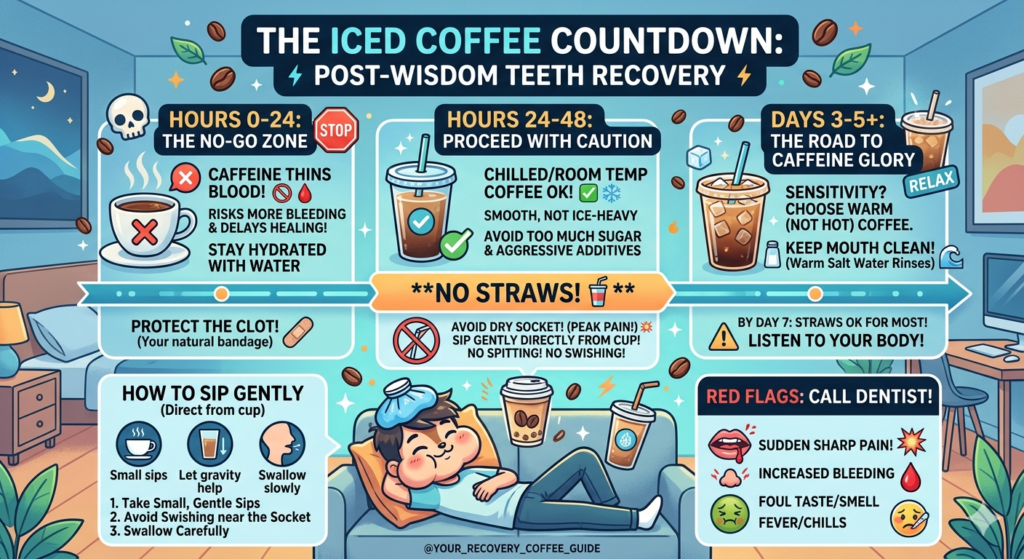
- Hours 0-24: No coffee. None. Zilch. Water and rest are your only friends.
- Hours 24-48: Chilled (not ice-heavy) coffee is okay. Drink from the rim of the cup. No straws. No sugar-overload.
- Days 3-5: You’re likely feeling a bit better. Iced coffee with straws is still risky, so I’d still avoid them. You can probably handle more “normal” coffee setups now.
- Day 7 and Beyond: Usually, by the one-week mark, your clots are pretty stable. You can likely go back to your full iced coffee glory, straws and all, unless your dentist told you otherwise.
When to Call the Dentist
If you decide to have your iced coffee and something feels “off,” don’t ignore it. Call your oral surgeon if you notice:
- Bleeding that won’t stop after you’ve had your drink.
- A sudden, sharp increase in pain (the “lightning bolt” feeling).
- A weird, foul taste in your mouth that won’t go away.
- Fever or chills.
These can be signs of infection or dry socket, and they need to be handled by a pro, not a blog post.
Final Thoughts from a Fellow Caffeine Addict
I know it feels like the end of the world when you can’t have your daily ritual, especially when you’re already feeling miserable from surgery. But wisdom teeth recovery is a marathon, not a sprint.
Taking two or three days to be really careful with how you consume your coffee will save you from weeks of potential pain. Be patient with your body. It’s literally rebuilding your jaw right now!
So, keep that ice pack on, keep your head elevated, and when you finally take that first sip of room-temp or chilled coffee from the rim of the mug, it’s going to be the best thing you’ve ever tasted.
Stay strong, don’t use a straw, and happy healing!
FAQ: Quick Hits for the Recovering
Can I have a Starbucks Refresher instead?
Same rules apply! They have caffeine and sugar, so wait 24 hours and skip the straw. Also, be careful with the seeds in drinks like the Strawberry Açaí—they can get stuck in your sockets.
What if I accidentally used a straw for one sip?
Don’t freak out. If it doesn’t hurt and it isn’t bleeding, you’re probably okay. Just don’t do it again!
Is iced coffee better than hot coffee?
Actually, yes. In the first few days, cold or room temp is much safer than hot. Heat can dissolve the clot, while cold (in moderation) can actually help with swelling. Just keep it “chilled” rather than “arctic.”